
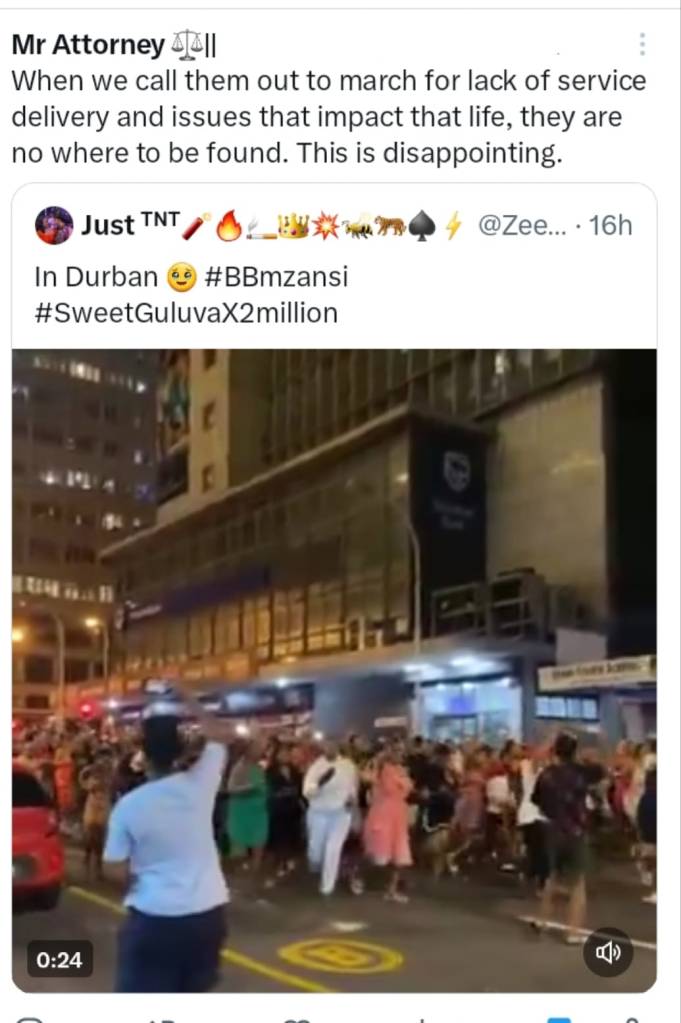
I strongly and aggressively disagree with the narrative that South African youth do not show up for things that matter.
South African youth are not passive by choice, they’ve been conditioned by systemic barriers, restrictive policies, and a political landscape that limits their agency. The reason they can mobilize for a reality show is because it resonates with them, includes them, and encourages their participation from the onset.
And let’s be very clear: the same young people in these videos are the ones on the frontlines of protests for service delivery, education, and human rights. These are students and young people who have been radicalized by watching those who led movements like #FeesMustFall, those who continuously protest against NSFAS failures, and those who, in many cases, stand up for their communities when politicians fail them. To act as if they only mobilize for entertainment is dishonest and insulting.
Blaming them for not showing up for marches while ignoring the role of those in power who have shaped media and education systems that disengage the youth from politics is unfair. Today’s youth are largely excluded from policies and politics and subliminally told their participation is not needed while a handful are picked to act as representatives of those youth. Their minds are consistently fed brain-numbing content by our national broadcaster, while DStv actively sets off on a mission that amplifies podcasts that do not uplift or educate black and brown youth but instead promote further degenerative content.
The youth of today were given OBE (Outcomes-Based Education) as a learning system—one that teaches students to absorb and regurgitate, rather than absorb and discuss. In the past, our schools had active debate clubs and conversation spaces, active use of the school libraries instead of the current hoarding of such spaces. Now, universities are forced to introduce modules like GDP (General Development Programmes) for first-years just to teach them comprehension, logic, and cognitive skills, skills that should have been developed in primary and secondary school.
We had TV shows like Take 5 that fostered critical thinking and active participation. We had The Felicia Show, where Felicia Mabuza-Suttle facilitated meaningful discussions on current issues, making these conversations accessible and engaging. What exists now in this day and age? A media landscape that prioritizes entertainment over civic awareness.
You can not expect youth to protest for service delivery or political issues on a whim, or when it suits a narrative, especially when they have not been equipped with the tools, media, and societal structures to nurture such engagement. And when they do take a stand, whether it’s for #FeesMustFall, housing crises, or administrative failures at universities—they are vilified, often by the very same people criticizing them now.
The real issue isn’t youth apathy; it’s selective outrage from people who refuse to acknowledge how power in South Africa has functioned at the expense of development, and how our current media and societal structures shape political consciousness.
We need to reflect before we direct such vitriol at the youth. Instead of condemning them, we should be working to change how media and education function, ensuring that the next generation is ready to challenge injustices as they are to rally behind a Big Brother Mzansi contestant.


