
This is not a review, but if it was to be one, I’d say this post sparked a review of how we are taught humility in our homes, while not all homes are the same, the core of this post is about the labour force and systems that are in place which do not serve the country. My off-shoot conversation around this will center more on home–economics because, in some cases, we leave behind the teachings of our mothers and fathers when we start existing in the world outside of that cocoon or “nest” of home.
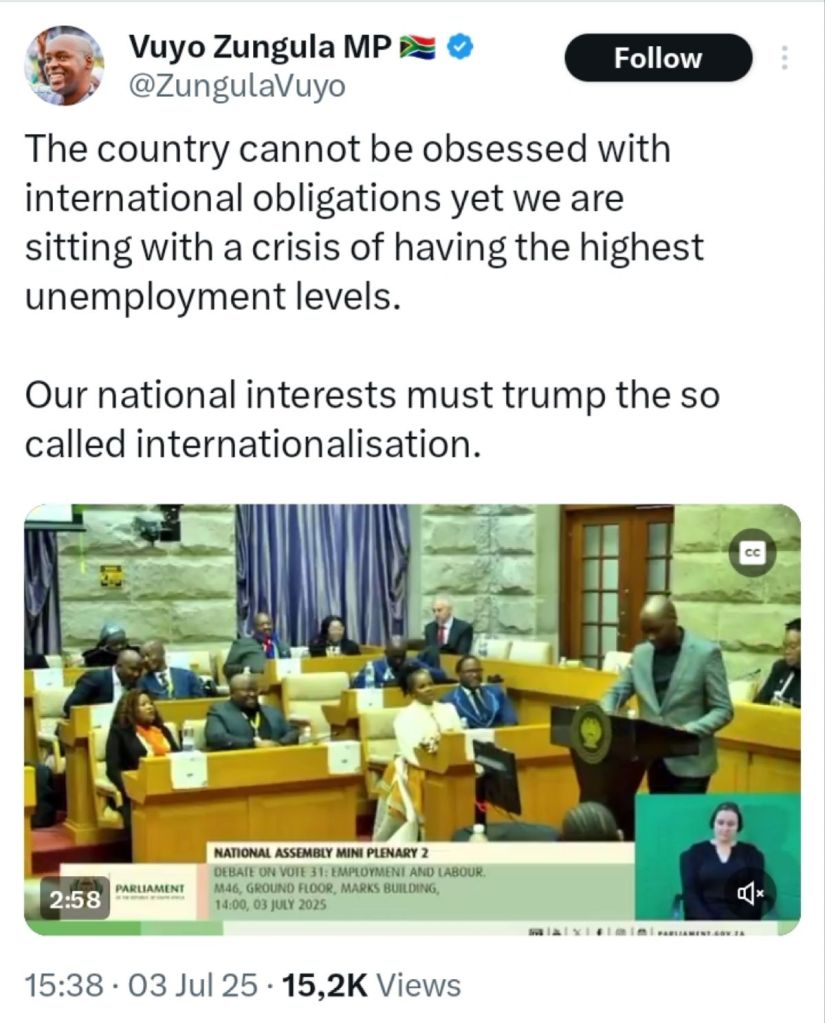
My initial reaction to the tweet by MP Vuyo Zungula is this quote:
“Charity begins at home” which is one of those phrases that felt like gospel growing up. My parents planted this deep within my core, but through lived experiences and observations, I find myself often thinking about how a simple truth wrapped in moral clarity is often performed but never truly practiced. It suggested a world where leadership began in the family, where a person’s true values could be observed in how they treated their own.
But in the South Africa I live in today, that saying feels more like performance than practice.
We live in a country where international obligations are often prioritised over internal ones, where it’s easier to shake hands abroad than it is to roll up our sleeves and fix what’s broken at home. Just this past week, MP Vuyo Zungula raised this very concern in Parliament: why are we obsessing over international duties while grappling with the highest unemployment levels in the world? His point is valid, and it touches on a much deeper societal mirror.
The truth is: this isn’t just about politics. It’s cultural. It’s traditional. It’s historical.
We come from communities where leaders are often celebrated for their public contributions, while their private homes tell a different story. Men who are hailed as elders, uncles, advisors, and moral authorities, yet behind closed doors, they are absent fathers, emotionally distant husbands, or even abusive partners. We are taught to respect them because of what they represent outside, never questioning what happens inside, as that is non of the public’s business or concern.
This disconnect between public honour and private neglect is not just hypocrisy, it’s a blueprint. A cultural normalisation that says as long as you show up for the world, you don’t have to show up for your family. And our political systems have adopted this same logic.
It’s easy for a community leader or politician to perform compassion on the world stage. It’s harder to live it out in the intimacy of their own home. It’s easy to fund or participate in international campaigns, hire international candidates for local jobs and roles, attend global summits, or sign declarations. But it’s harder to fix education, service delivery, or unemployment here at home. One is optics. The other is accountability.
And that’s why our political leadership often mirrors our most broken traditional patterns. If our grassroots approach to leadership neglects the home, our national politics will reflect that very nature.
I dont have the bandwidth to extend my thoughts at length around this, but I am a stronger believer in that with every criticism, comes a chance for redirection.
A solution I deeply believe in, lies at rebuilding our cultural and traditional compassions, re-centering leadership around those who holistically “take care of home.” What would happen if we began choosing leaders not by their speeches, but by their family’s testimonies? If the mark of great leadership was not only what they say in public, but how they are experienced in private?
Not the father who grants his nephew a tender through corruption, but the one who raises his children with presence, consistency, and humility. Not the uncle who boasts about community meetings while his own household crumbles, but the one who leads a home where everyone feels seen and supported.
Yes, we must be careful because “taking care of family” in South Africa is often misused to justify nepotism, cronyism, and the type of corruption currently being unpacked in the National Lottery scandal. That version of “family-first” is not rooted in care, it’s rooted in greed. It’s the illusion of homebuilding through material access, rather than emotional responsibility and ethical leadership.
In both our private and public lives, there’s a pattern that plays out too often: the façade of responsibility for the world, while neglecting the very people and systems closest to us. We see it in politics, where our government makes commitments to international bodies while millions go hungry and unemployed at home. But we also see it in our cultural and traditional structures, where leaders are praised as community leaders yet fail their own families.
In many ways, this is the performance of care, a carefully curated image of honour, with none of the intimate labour it requires. And perhaps that’s the issue: “Charity begins at home” has become a slogan for respectability, not a principle of practice.
So here’s the question we must ask: does the leader we celebrate have a family that celebrates him too? Not for what he provides materially, but for how he shows up emotionally and spiritually? Is he gentle? Is he present? Is he honest?
Because maybe the kind of leader we need for the future of this country is the one who is already practicing leadership at home.
This dissonance isn’t just cultural. It’s systemic. And until we reconcile the gap between what we preach and what we practice, we will keep raising generations in homes, in communities, and in a country where care is talked about more than it is lived. And where international relations are a lucrative form of windowdressing on a global stage.
Disclaimer: The use of “men/man” in this unfortunate think piece is not to exclusively claim this behavior or character trait is exclusive to one gender only, im sure there are some women in leadership roles who also exibit the same lack of compassion in their homes but are fully celebrated in public. Iyenzeka lonto, macala.
Danko for reading. Please subscribe to the blog


