
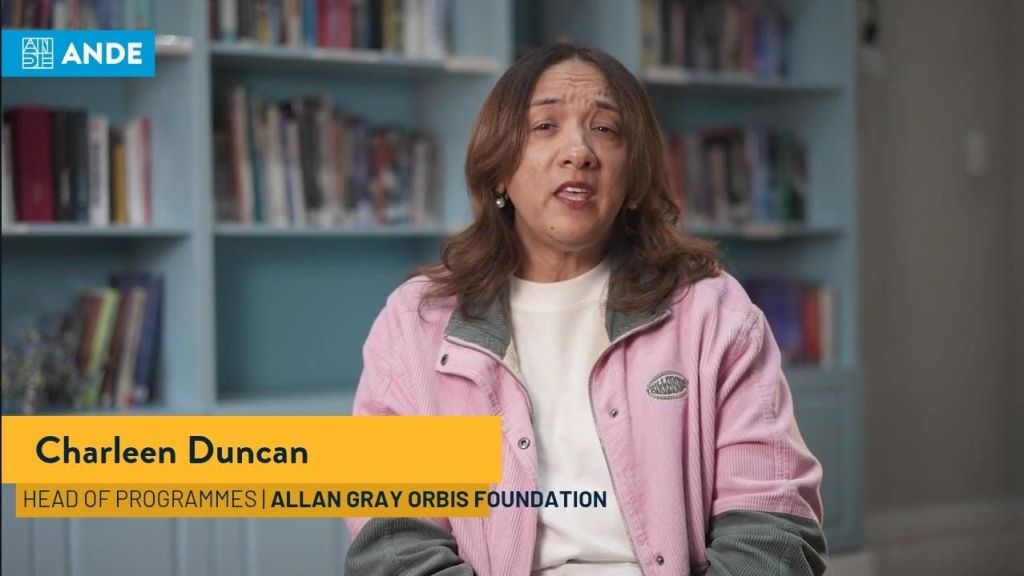
This is not a review, but it is a piece inspired by Charleen Duncan’s contribution and participation at the 2025 Aspen Network of Development Entrepreneurs Conference, as calls to “support entrepreneurship” across the Global South have never been louder. From pitch competitions and accelerators to innovation hubs and venture funds, the language of opportunity is everywhere. Yet, for all this activity, exclusion remains stubbornly intact. The Allan Gray Orbis Foundation’s (AGOF) recent call to redesign entrepreneurial ecosystems confronts an uncomfortable truth many in the sector would rather avoid: the problem is not a lack of entrepreneurial potential, but the systems that determine who gets to succeed.
Speaking at the 2025 Aspen Network of Development Entrepreneurs (ANDE) Conference, in Mexico, AGOF’s head of public affairs and communications, Charleen Duncan, articulated what many founders experience but few institutions openly admit, entrepreneurs from marginalised backgrounds are expected to perform within frameworks that were never designed with them in mind. When success requires conformity to dominant norms, networks and narratives, exclusion is not accidental. It is therefore structural.
This matters because entrepreneurship has been positioned as a solution to unemployment, we do that in South Africa so often while inequality and economic stagnation across South Africa and the wider Global South dominates. We can see that when access to opportunity is mediated by elite networks, inherited social capital, and narrow definitions of “investment readiness”, entrepreneurship risks reproducing the very inequalities it claims to solve.

We can agree that inclusion can not be cosmetic. While reading more about AGOF’s intervention theory, it is clear that this is not a call for more diversity panels or symbolic representation, it truly is a challenge to the architecture of the ecosystem itself. As Duncan notes, inclusion cannot be retrofitted. Inviting a handful of new voices into old rooms does not redistribute power, it merely changes the optics.
True inclusion requires designing ecosystems with historically excluded founders, not attempting to assimilate them into systems that privilege-polish over potential. It means questioning who defines viability, which business models are legitimised, and why certain forms of entrepreneurship are systematically undervalued.
Community-based enterprises, informal businesses, and cooperatives are often framed as transitional or inferior to venture-backed startups. AGOF now rejects this hierarchy outright, arguing that these models are not lesser, they are “differently powerful” and I fully agree with this observation. In contexts where survival, reinvestment, and collective benefit matter as much as scale and exits, this reframing is essential.
There is a myth of short-term readiness, one that I’m overly familiar with. One of the most important and disruptive ideas in AGOF’s position is its critique of short-term pitch performance as a proxy for entrepreneurial merit. The obsession with pitch decks, demo days and rapid validation favours those already fluent in the language of capital, these became even more popular around the growth of TV shows that promote and thrive in reality TV formats of instant fame and fortune. These reward confidence over competence, access over ability, and exposure over endurance.
Long-term entrepreneurial success, particularly in unequal contexts, is not built in six-week programmes or judged in five-minute presentations. It is cultivated over years through mentorship, identity formation, peer support, and the slow accumulation of skills and confidence, much like TINAR, which is gradually growing from a blog to a media entity. AGOF’s emphasis on belonging, psychological safety, and personal development recognises that entrepreneurship is as much an emotional and social journey as it is a commercial one.
If investment readiness is treated as an elite outcome rather than a developmental process, the ecosystem will continue to filter out capable founders before they have the opportunity to mature.
Education is the real intervention so
perhaps the most consequential part of AGOF’s call lies in its focus on education as the foundation of ecosystem reform. Embedding entrepreneurship into South Africa’s basic education system is not about producing teenagers with business plans, it is about cultivating agency, problem-solving, resilience, and self-belief from an early age.
Initiatives like the Allan Gray Entrepreneurship Challenge signal a shift away from rewarding polished outcomes toward investing in raw potential, I have followed the AGEC for three years now and can see its impact. This approach recognises that readiness is taught, not inherited, and that exposure and encouragement at school level can fundamentally alter who sees themselves as an entrepreneur in the first place.
When entrepreneurship is introduced late, at university, in accelerators, or at the point of funding, it already is at the privilege of those who have had years of informal preparation through family businesses, elite schooling or professional networks. Education is where the playing field can begin to level, and how do we ready schools into this mindset? How do we engage principals at schools who will not see this as a visionary and sustainable framework? Perhaps this is where a number of us need to probe into and infiltrate at the root.
Ending elitism in opportunity has many faces. AGOF’s final challenge is the most confronting: South Africa’s entrepreneurial ecosystem was built by a few, for a few. Its norms, language and power structures continue to preserve privilege under the guise of meritocracy. Until this is acknowledged, reform efforts will remain superficial.
Ending elitism in entrepreneurial opportunity does not mean lowering standards. It means changing what we measure, who we listen to, and how long we are willing to invest in people. It means shifting from gatekeeping to partnership, from extraction to co-creation, and from speed to sustainability.
Potential exists everywhere. What is scarce is systems that are willing to nurture that potential without demanding conformity. AGOF’s call is not simply for more entrepreneurs, but for ecosystems brave enough to be redesigned.
Where I stand, if entrepreneurship is truly to serve shared prosperity, then rebuilding the foundation is not optional, it is overdue.