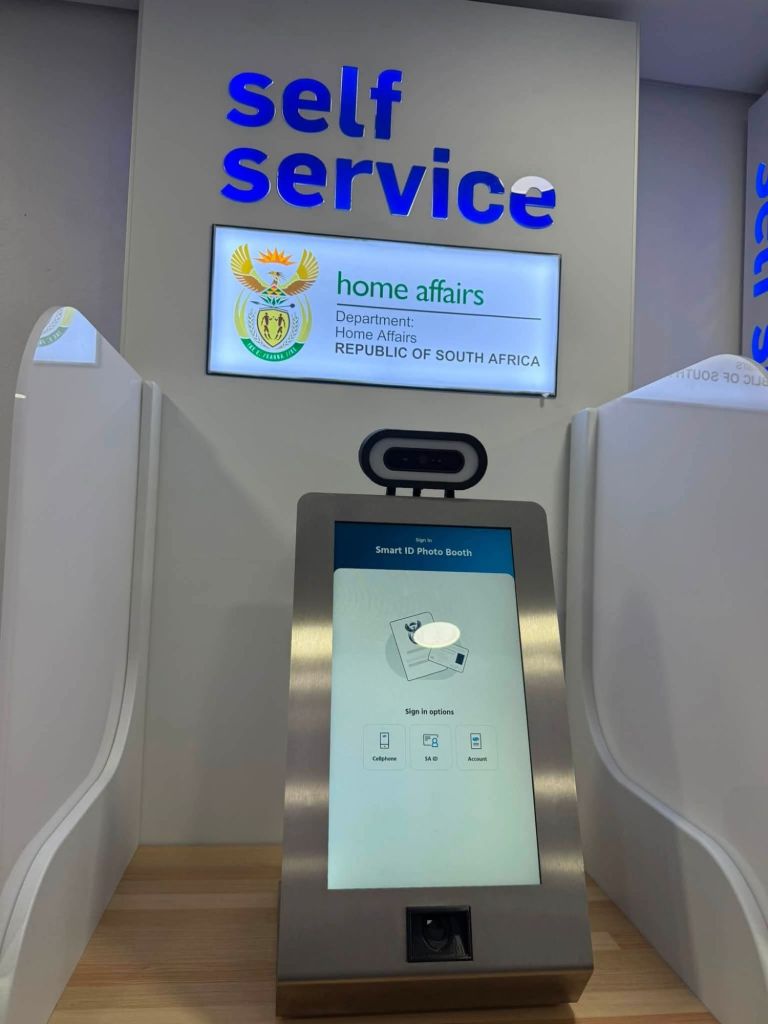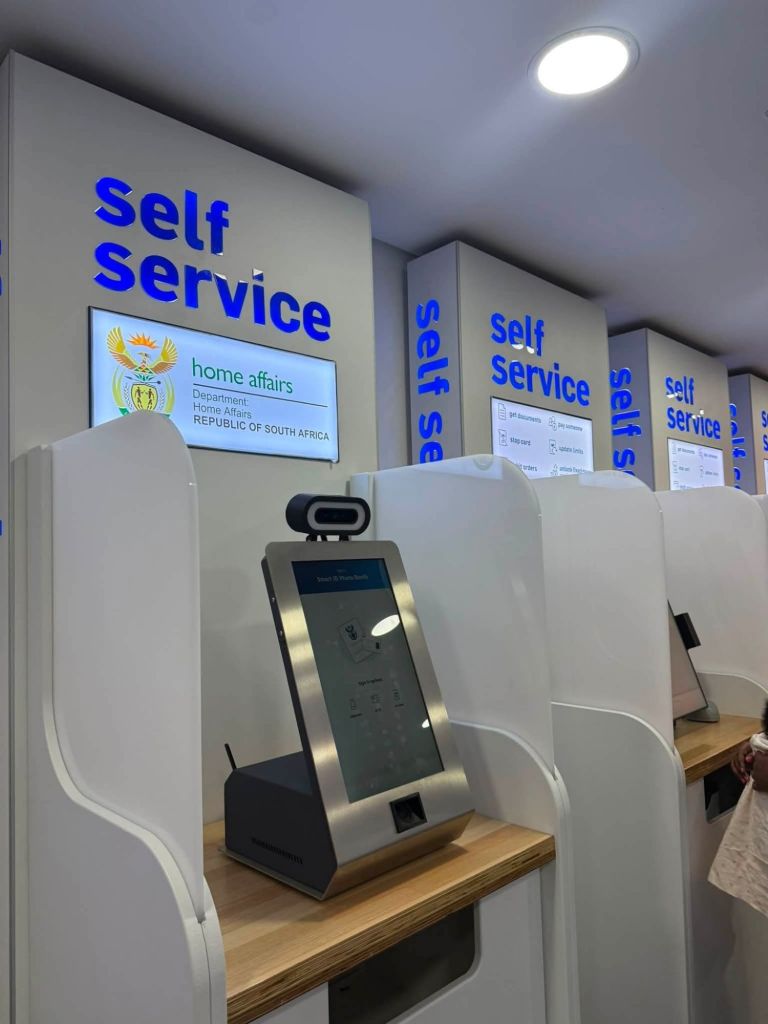
I saw a photograph recently that tickles my dot connecting brain and made me think of a few things, which eventually made me slightly uncomfortable. It was a photograph of the Capitec self-service terminal, offering South Africans access to Home Affairs services, this photo was accompanied by a caption celebrating the fact that a Smart ID application could be completed in less than five minutes. The excitement was understandable, anyone who has previously had to deal with the former administrative reality of Home Affairs knows that a few years ago, getting an identity document can become an unnecessarily exhausting exercise. The last two trips to home affairs have been rather seemless for me both for an ID card and a passport, that is why I say “former”, but my experience may not be everyone elses and in most cases the system still seems to lag.
Which is why I can also understand that the possibility of walking into a bank, completing the process quickly and leaving without spending hours in a government queue is, quite frankly, something worth celebrating. My immediate thought to that post, however, was: “Oracle must be so proud of South Africa right now. 🔥😍💀” The Oracle comment is, of course, sarcasm. I am not suggesting that Oracle is behind Capitec’s Home Affairs service upgrades. In fact, Capitec has stated that the proprietary technology connecting its self-service terminals to Home Affairs is built on Amazon Web Services. What made me think of Oracle was the much larger technological direction represented by that little machine: the integration of institutions, data, identity and financial infrastructure until the boundaries between services become increasingly invisible to the person using them.
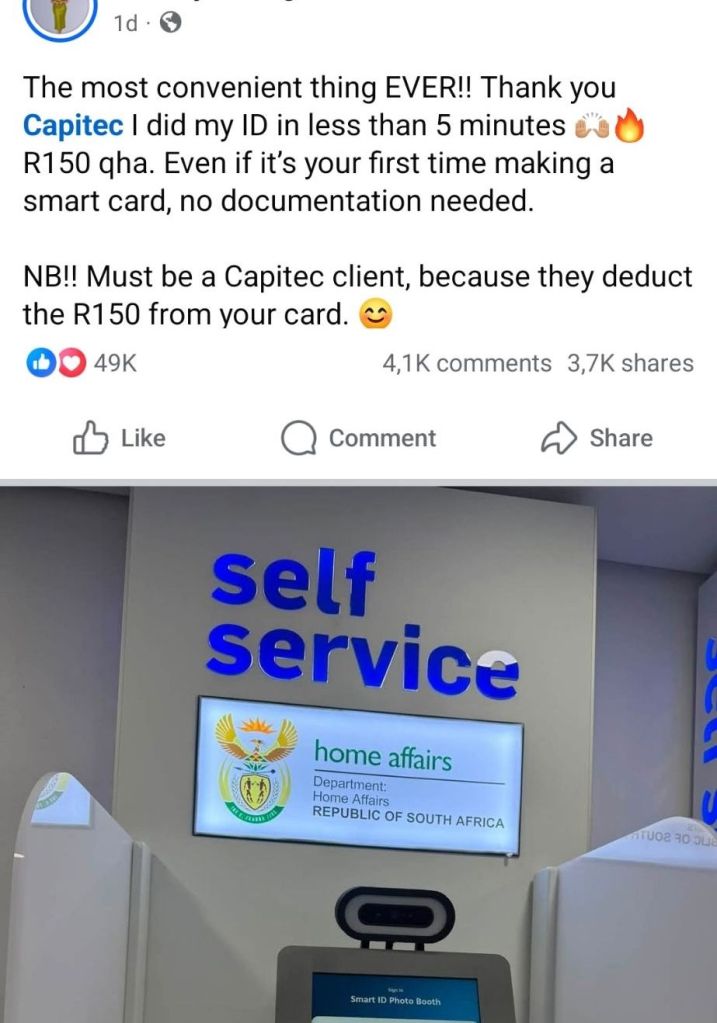
This is a not a review, but it is ramblings of pattern recognition, and I may not have a way of presenting my thoughts right now but, this is as much of my thoughts I can processes with a small audience.
The Capitec and Home Affairs partnership is an excellent example of this shift. Capitec launched its in-branch Smart ID service in partnership with the Department of Home Affairs in 2026, allowing customers to apply through dedicated self-service terminals without making a prior booking. Capitec says the process is paperless, takes less than five minutes and is fully integrated with DHA systems for real-time processing. More significantly, Capitec describes itself as the first bank to move beyond simply having Home Affairs officials stationed inside branches, instead developing its own digital integration, built on Amazon Web Services, which connects the terminals directly to Home Affairs systems. The Department of Home Affairs is also deliberately expanding this model. Its 2026/27 Annual Performance Plan includes a target of integrating 200 bank branches with its live-capture platform for Smart IDs and passport re-issues. In other words, this isn’t merely a bank offering an additional convenience to its customers. It is part of a deliberate movement towards government services being accessed through private-sector infrastructure.
And this is where I find myself caught between appreciation and concern. I absolutely understand the appeal. In fact, I think the convenience is fantastic. If a person can access an essential identity service at a bank close to home instead of travelling to a Home Affairs office, taking time off work, waiting in a queue and potentially losing income simply to obtain an identity document, then something has clearly improved. There is dignity in efficient public services. There is dignity in being able to complete an administrative task in five minutes instead of having your entire day consumed by it. Capitec itself frames the initiative around this question of access, cementing that an identity document is a catalyst for economic participation and that its infrastructure can help address the long journeys and queues associated with accessing Home Affairs.
With that in mind, among other matters, I am not interested in pretending that bureaucratic inconvenience is somehow more virtuous than technological convenience. If the system works, people should absolutely use it.
But the political question underneath that convenience is much harder to ignore. At what point does the provision of government services become so dependent on private institutions that we effectively begin to privatise access to the state? Home Affairs remains a government department, granted, banks have not suddenly taken ownership of South Africa’s identity system, and it would be inaccurate to describe the arrangement as the privatisation of Home Affairs itself. What is changing is the interface between the citizen and the state. One would have us believe that government remains responsible for identity, but a private bank increasingly becomes the place where the citizen interacts with that government system. That distinction may sound technical, but I think it is politically significant. If the state cannot provide citizens with a reliable, accessible and efficient identity service through its own infrastructure, but private institutions can provide the physical locations, technology and user experience through which citizens access that service, then we have to ask what this says about the capacity of the state itself.
I have a massive gripe with the way our government repeatedly fails ordinary South Africans through inefficient service delivery, and identity is not a minor administrative matter. An identity document is foundational to participation in modern society. It connects people to banking, employment, education, travel, social services and countless other aspects of citizenship. So I struggle with the question of what the purpose of government becomes if it cannot reliably take care of the identity needs of its citizens from beginning to end. Government does not necessarily have to build every piece of technology itself. There is nothing inherently wrong with a government department partnering with a bank, hiring a technology company or using cloud infrastructure. In fact, modern governments will inevitably rely on private expertise and infrastructure. My concern begins when the private sector becomes so deeply embedded in the delivery of essential public services that the citizen’s experience of government can no longer be separated from the corporation providing the access point.
This is where my sarcastic Oracle reference becomes relevant, because Oracle represents a broader technological philosophy that is happening far beyond South Africa. Oracle’s financial-services business is actively building infrastructure designed to make different payment systems communicate with one another. Oracle Banking Payments describes itself as a unified platform for local and cross-border payments, while its current payments architecture is built around ISO 20022, an international standard designed to structure financial messages and improve interoperability between payment systems. Oracle explicitly describes the global payments environment as increasingly “hyper-connected” and positions its technology around real-time processing, multiple payment types, cross-border transactions and the integration of previously fragmented payment infrastructure. Oracle has also highlighted its SWIFT compatibility and the role of standards-based infrastructure in payment security, interoperability and regulatory compliance.
That is why I find the Capitec photograph so interesting in relation to the larger global landscape. I am not suggesting that an AWS-powered Home Affairs kiosk is somehow part of an Oracle project. It isn’t. The connection is conceptual. Oracle’s work in financial infrastructure represents a world in which separate systems increasingly need to communicate with one another, while the Capitec and Home Affairs partnership represents a South African example of two previously distinct institutional environments becoming connected through digital infrastructure. The bank does not become Home Affairs, and Home Affairs does not become Capitec. Instead, their systems communicate, and the citizen experiences the result as one seamless service. That is increasingly how integration works: not necessarily by creating one enormous system, but by creating bridges between systems that were previously separate.
And that same principle is increasingly visible in global payments. The world does not necessarily need one global bank or one global payment platform for financial systems to become globally integrated. What it needs is interoperability: common standards, compatible infrastructure, digital authentication, APIs, payment messaging and systems capable of communicating across institutional and national boundaries. Oracle’s own banking material explicitly identifies lack of global interoperability, siloed data, legacy systems and integration complexity as challenges facing financial institutions, while positioning its payments infrastructure as a way to connect payment types and modernise those systems. The company’s broader 2026 banking strategy also puts interoperability, real-time data, cloud-native architecture and integrated systems at the foundation of what it describes as the next generation of banking.
There is therefore something bigger happening than simply making life easier. Our institutions are learning how to talk to one another. Our bank accounts can increasingly interact with systems beyond traditional banking. Our identities can increasingly be verified digitally. Government services can increasingly be accessed through private infrastructure. Payment systems are being standardised so that different institutions and countries can communicate more efficiently. And the technology sitting underneath these interactions is increasingly operated by companies that ordinary citizens may never encounter directly. The person standing at that Capitec terminal doesn’t see Amazon Web Services, biometric authentication, DHA databases, payment infrastructure or system integrations. They see a screen, enter their information, complete the process and walk away with the feeling that the system finally works. That is the genius of good infrastructure: it makes an enormous amount of complexity feel like almost no complexity at all.
But seamlessness creates its own questions. The more integrated our systems become, the more important questions of ownership, accountability, privacy, security and dependency become. Who owns the infrastructure? Who is responsible when it fails? What information is exchanged between institutions? What happens when a public service becomes dependent on a private platform? What happens when private companies become so deeply embedded in the functioning of government that removing them becomes practically impossible? These aren’t arguments against technology or integration. They are questions about governance. I can celebrate a five-minute Smart ID application and still ask whether the state should have needed a private bank to make that five-minute experience possible in the first place.
Perhaps that is what bothers me most about the photograph. It is incredibly easy to celebrate because the immediate outcome is good. A citizen has been spared unnecessary bureaucracy. A government service has become faster. A bank has used technology to solve a real problem. Nobody standing in front of that machine needs to care about the architecture underneath it. And perhaps that is exactly how these transformations become normal. They arrive as convenience. They arrive as better customer experiences. They arrive as services that save us time. By the time we realise how deeply our institutions have become interconnected, the integration is no longer something being introduced to us; it is simply the way society works.
I don’t want to reject that future. Quite the opposite. I want government services to be seamless. I want payments to move efficiently. I want people to be able to prove their identity without losing a day’s wages. I want technology to remove unnecessary barriers from people’s lives. But I also want us to remain intellectually curious about what makes that seamlessness possible. Because every layer of infrastructure has an owner, every system has a cost, every partnership creates a dependency and every convenience changes the relationship between the citizen, the state and the private sector.
That is ultimately why my Oracle comment was sarcastic. I wasn’t celebrating some imagined Oracle takeover of South African government services. I was laughing at how perfectly this tiny South African development fits into a much bigger global movement towards integrated infrastructure, interoperable financial systems and increasingly invisible technological layers connecting institutions. Oracle is one of the companies building that future in the financial-services space, while companies such as Amazon provide the cloud infrastructure upon which other forms of institutional integration are being built. The names and technologies will change, but the direction is unmistakable: more systems talking to more systems, with less friction for the person standing on the other side of the screen.
And perhaps we should enjoy the convenience. We should. But we should also remember that seamlessness is not the same thing as free. Someone builds the infrastructure, someone owns it, someone maintains it and someone ultimately pays for it. Maybe the cost is financial. Maybe it is institutional dependency. Maybe it is through contracts between governments and corporations. Maybe it is through the value attached to our data. Maybe the consequences won’t become obvious until systems become so interconnected that walking away from them is no longer realistic. I don’t know what form the bill will eventually take.
But I suspect there will be one.
Perhaps not in this timeline. Perhaps not even in ours. But somewhere in the timeline of our children or grandchildren, the piper will come looking for payment. And when that happens, I hope we can say that while we were enjoying the convenience, we were also paying enough attention to understand exactly what we were building.