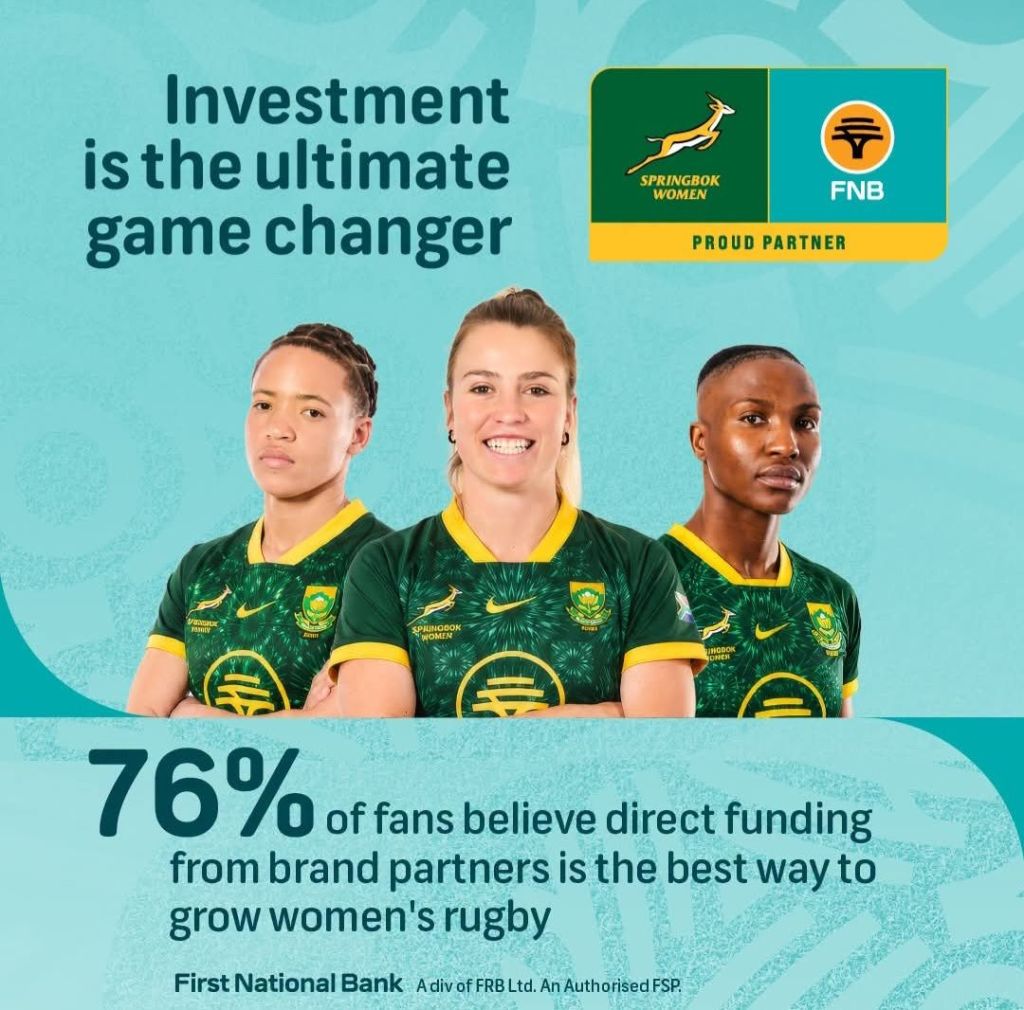
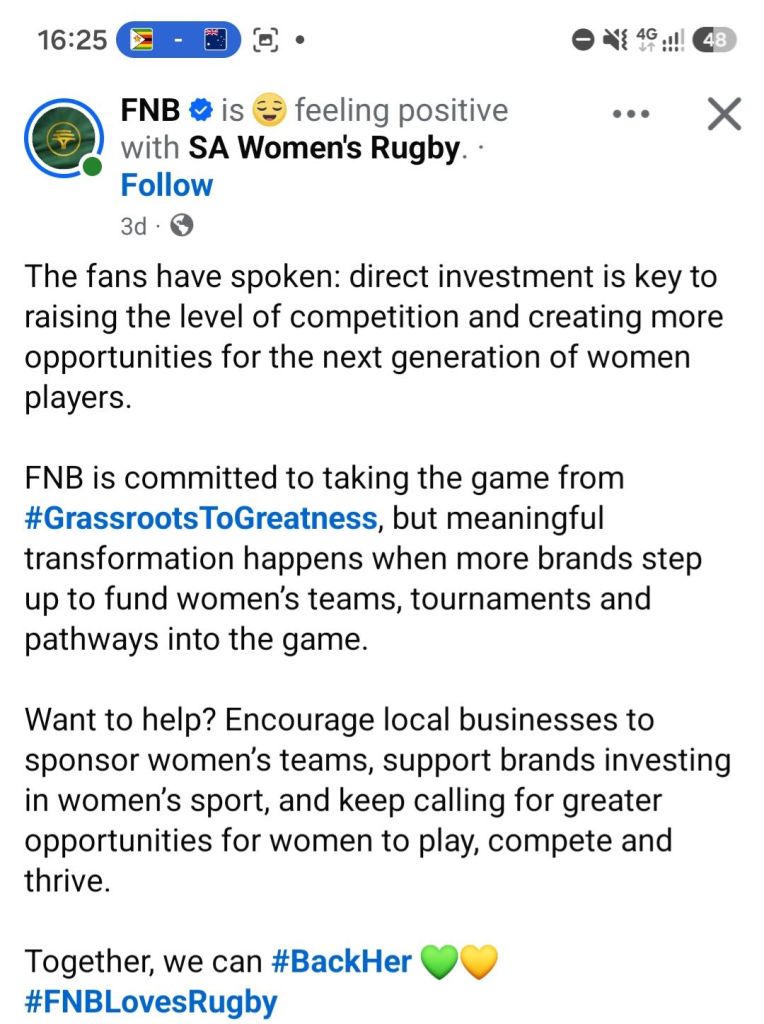
FNB’s latest message around women’s rugby makes a simple but important argument; “Direct investment can be a game changer”. In a post supporting SA Women’s Rugby, the bank says 76% of fans believe direct funding from brand partners is the best way to grow women’s rugby/sports, and calls on businesses to support women’s teams, tournaments and pathways into the game. The message is clear and encouraging because it moves the conversation beyond visibility and towards resources such as money, the one thing that ultimately allows sporting systems to build, compete and sustain themselves.
So it is normal that this post raises a question that extends well beyond rugby, where we get to ask: When brands say they are investing in women’s sport, what exactly are they investing in?
Cricket is a useful place to ask that question. South African women’s cricket has made undeniable progress, from the professionalisation of the national team to repeated World Cup finals and a growing domestic structure. There are also genuine examples of commercial support such as the Momentum’s ten+-year relationship with the Proteas Women, which helped move the team from amateur to professional status and seemingly provided support across the pathway, while newer partnerships such as KFC’s expanded relationship with the Proteas Women and AdvTech’s support of women’s international and youth cricket show that investment is happening, most of it is still unclear as to what degree of financial support is being poured into womens cricket, which amplifies the argument that effort is not the same thing as a sufficiently developed systems. Too often, women’s cricket still appears to be treated as an extension of an existing men’s cricket product rather than as a sporting property with its own commercial identity, audience and development needs. Even at domestic level, the structure tells a story: CSA currently separates the women’s game into Hollywoodbets Pro Series divisions, while teams such as Boland Women have operated in Division 2, meaning the pathway and level of competition are not yet equal across the provincial landscape, which means on the ground support isnt visible enough to build commercial appeal which in it’s own capacity isn’t being fostered well enough to trickle and meander into the pathway.
Then there is the sponsorship question. Some Division 1 women’s teams have strong associations with brands, but the broader commercial ecosystem does not yet consistently show the kind of women-specific investment, storytelling and activation that could turn these teams into commercially recognisable properties in their own right. A team can carry a sponsor’s name, wear a branded shirt and still have very little surrounding commercial activity that tells supporters why that women’s team matters. At national level, there are encouraging developments, Jonsson Workwear, for example, now has branding across both the Proteas Men and Women, while Radar Tyres is positioned across men’s, women’s and junior national teams, all that illustrates the distinction between being included in a sponsorship and being independently invested in as a property. Inclusion matters, we can all agree to that, but It is not, however, the same as building a commercial proposition specifically around the Proteas Women and ultimately, the womens game.
This is where brands that support cricket can learn something from the language in FNB’s rugby message. If investment is genuinely supposed to raise the level of competition and create opportunities for the next generation, then it cannot consistently arrive after the men’s product has already been packaged, sold and activated. It has to reach the provincial team, the tournament, the player pathway, the coach, the facilities, the medical and performance environment, the content team and ultimately the fan. Boland Women competing below the top domestic tier is not simply a sporting statistic, it is part of a wider conversation about how women’s cricket is developed and commercialised outside the national spotlight. The same applies when a promising player becomes visible only once she reaches the Proteas. In most conversation around the womens game, I often argue that investment should be building the road to the national team, not merely decorating the destination.
There is no question that South African cricket is making an effort, and that deserves acknowledgement. CSA’s current partnerships and its continued investment in the women’s professional structure demonstrates some movement, while the Proteas Women continue to receive significant international attention and opportunities. But from the outside, the progress does not yet consistently show up in ways that fundamentally change the experience of women cricketers and the commercial value of women’s teams. That is the conversation FNB’s rugby post opens up so well and perhaps many questions also arise from it. I can agree that it is no longer whether women’s sport deserves investment, we know it does. The more important question now is whether brands, federations and sporting organisations are prepared to invest early, deliberately and innovatively enough to build the ecosystem, rather than continuing to treat women’s sport as a “by the way, we also have a women’s team” statement, or being the last addition to a sponsorship announcement press release that was designed around the mens team.
FNB’s latest #BackHer message puts direct investment at the centre of the conversation around women’s rugby. But if brands are serious about changing the game, the question is no longer whether women’s sport deserves investment. It is what that investment should actually build.