Is there something almost contradictory about the idea of a Silent Book Club? I wonder this so much as I recall my participation in a two local book clubs, out of the two, the silent book club has my marketing brain running on overdrive, it is a social gathering built around not talking, yet that contradiction is precisely what has allowed the initiative to travel from a neighbourhood wine bar in San Francisco to thousands of chapters around the world. Silent Book Club began in 2012 when friends Guinevere de la Mare and Laura Gluhanich began reading together at their local wine bar, eventually formalising the organisation in 2015. The premise was deliberately uncomplicated. There is no assigned book, no reading deadline and no expectation that anyone must contribute an intelligent observation about what they have read. Readers simply bring their own book, meet in a shared public space, read together for an hour or so and then decide whether they want to socialise afterwards. Today, the Silent Book Club describes itself as a global community with more than 2,000 chapters across more than 65+ countries, built around the idea of reading in “quiet camaraderie”.
I like this for many reasons, as South Africa has become part of that global story, with a few outlets in and around parts of Southy, the country’s relationship with Silent Book Club becomes particularly interesting to me when the conversation moves to Cape Town. The Cape Town chapter was started by Shawn Buck after he encountered the concept while visiting a overseas gathering, eventually bringing the idea home and turning it into a local community. What began as a simple reading gathering has developed into one of the most visible chapters in the global network. Silent Book Club has previously listed Cape Town as its second-largest chapter in the world, measuring the ranking by Instagram following, with 35,000 followers at the time of that global feature. By 2026, the organisation reported that the chapter had grown beyond 41,000 followers, alongside gatherings that can attract hundreds of people. The scale is perhaps best understood through some of the chapter’s own experiences where a January 2026 train gathering to Kalk Bay attracted around 500 people, while the chapter has also turned sections of Bree Street into an enormous outdoor reading room during pedestrian-only Open Street Sundays.
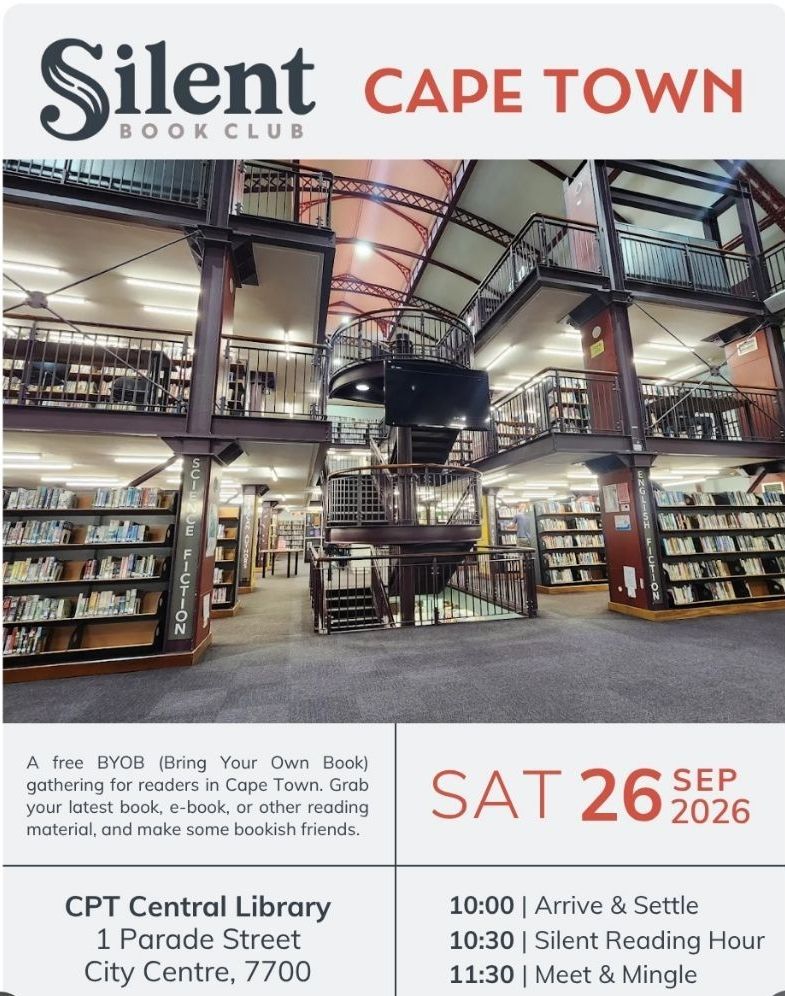
And this is where TINAR gets to explore even further as the numbers are not really the most interesting part of Cape Town’s Silent Book Club story. The more significant achievement is what those numbers represent- connectivity: people choosing to occupy physical space together without being required to perform for one another. A person can arrive alone, bring a completely different book from everyone else, sit among strangers and still participate fully. The chapter has deliberately moved through different kinds of Cape Town spaces, from beaches and parks to restaurants, breweries, theatres, trains and cultural venues, creating an adaptable format that allows the reading community to experience the city while experiencing one another. Its September 2026 gathering at Cape Town Central Library is particularly fitting, after almost two and a half years and thousands of suggestions from its community, the chapter is finally gathering inside the city’s central library.
This is also where the commercial viability of the model becomes difficult to ignore from a TINAR perspective. Silent Book Club creates a reliable audience that moves between physical spaces. A café can become a reading room, a theatre foyer can become a gathering place, a museum, brewery, bookstore, restaurant or public space can temporarily become part of the community’s routine, maybe even a cricket match out in Newlands… The value is not simply that hundreds of people may arrive, but that they arrive with a reason to remain in a space for an extended period, often consuming the scenery, food, coffee or other services around the gathering. The global organisation itself describes its events as free and supportive of local businesses, while Cape Town’s calendar demonstrates how deliberately the chapter moves between venues and partners. The commercial proposition therefore sits alongside, rather than replacing, the human one, though its a small contribution, businesses do gain access to an existing community, while communities gain reasons to discover and return to physical spaces.
Perhaps that is the quiet lesson of the Silent Book Club. In a time where so much social interaction happens through screens, algorithms and carefully managed digital identities, Cape Town is perhaps consistently demonstrating that people will still turn up simply to sit beside strangers and read. Having participated and enjoyed the Cape Town Silent Book Club, I think and feel that the success of the chapter is definitely not only its follower count, the hundreds of attendees or its position as one of the largest Silent Book Club communities in the world, it is the fact that those measurements have translated into actual human presence. The model creates a reliable audience that moves between physical spaces, but more importantly, it creates opportunities for people to encounter one another without demanding that they entertain, network or explain themselves.
Everyone arrives with their own story, their own book and their own reason for being there, and for an hour or two, those individual lives occupy the same space. That may be the most valuable thing Silent Book Club has built, not simply a community of readers, but a reason for people to be together without the extra fluff and hype of social gatherings a version of slow-living and human connectivity that doesnt need loud music, liquid courage and groove.


