
For more than five decades, the Nedbank and Old Mutual Budget Speech Competition has been creating opportunities for South African students to engage with the country’s economic future, and its 55th edition is making an even bigger invitation to young talent. Established in 1972, the competition challenges university students to think beyond their lecture notes and engage with the economic and fiscal questions shaping South Africa. This is not simply an essay-writing exercise, it is an opportunity to develop and present ideas about the country’s economic direction while gaining exposure to people and institutions involved in the financial and policy landscape. With a combined prize pool of R630,000, the 2026 competition is positioning itself as a platform for developing the next generation of economists, business professionals and public policy thinkers. For students who have an interest in how economies function, how governments make financial decisions and how businesses contribute to economic development, this is an opportunity worth exploring.
One of the most interesting developments in this year’s competition is its broader invitation to students beyond traditional economics qualifications. Full-time and part-time undergraduate and postgraduate students at recognised South African higher education institutions can enter, provided they meet the competition’s academic and other eligibility requirements. Undergraduate students studying Economics as a module within another qualification are encouraged to consider entering, while postgraduate participation includes students in Honours and first-time Master’s programmes. The competition specifically identifies disciplines such as Economics, Finance, Development Studies, Business and Public Policy as areas from which it wants to attract emerging talent. This is particularly relevant to students in faculties such as Economic and Management Sciences, where classroom discussions about business, finance, development and public policy can translate into practical contributions to national economic debates. Importantly, the published competition rules require participants to be registered for an economics course, so students should check the full eligibility requirements before submitting. The expansion of the competition is an acknowledgement that the country’s economic future cannot be shaped by one discipline alone. Different academic perspectives have a place in conversations about how South Africa grows, creates employment and manages its resources.
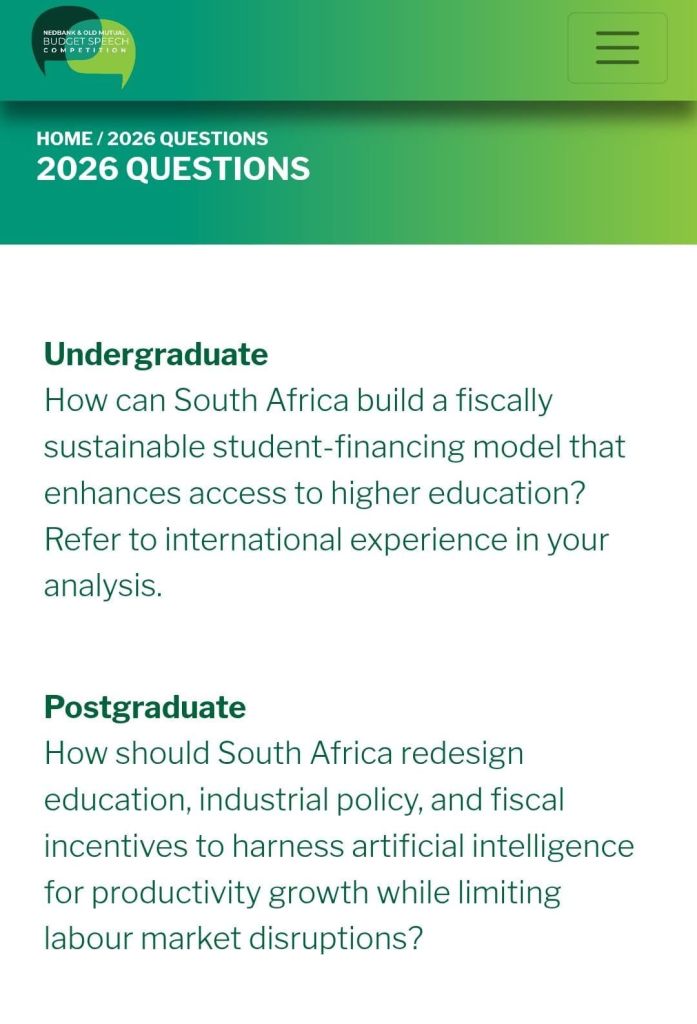
The questions set for the 2026 competition bring those conversations into focus. Undergraduate entrants are challenged to consider how South Africa can develop a financially sustainable student-funding model that improves access to higher education, drawing on international experience. Postgraduate entrants are asked to examine how education, industrial policy and fiscal incentives should be redesigned to help South Africa benefit from artificial intelligence while limiting disruptions to employment. Both questions invite students to engage with issues that extend beyond academic theory and into the everyday realities of South African society. From the affordability of university education and the future of student funding to technological advancement, productivity and the changing nature of work, these are matters that will influence the opportunities available to the next generation. Students are therefore being invited to do more than identify problems… they are being asked to develop considered, evidence-based recommendations. It is also an opportunity to demonstrate that young people are not merely recipients of economic decisions but can contribute meaningful ideas to the conversations informing them.

Of course, a competition of this nature needs to reward more than participation, and its adjudication process reflects that expectation. Essays are assessed across five areas, with 60% of the available marks allocated to content, the development of the argument and organisational structure. A further 15% is awarded for original ideas and recommendations, 10% for the problem statement and introduction, 10% for the conclusion and 5% for language, grammar and presentation. In other words, having a strong opinion is a starting point, but students must demonstrate an ability to research, reason, construct an argument and communicate their recommendations effectively. This is precisely the kind of intellectual development that has value beyond a competition. Being able to examine a complicated economic issue, interpret evidence and present a coherent position is useful in business, financial services, research, public administration and policymaking. For university lecturers and academic departments, this is also an opportunity to encourage students to apply their classroom learning to a national platform where their thinking can be recognised and challenged.
There is another dimension worth considering, the relationship between corporate investment in education and the development of future talent. Nedbank and Old Mutual are not simply offering cash prizes, through this competition, they are creating an opportunity for students to interact with the financial sector and gain exposure to people working within it. The competition’s top 20 finalists, comprising 10 undergraduate and 10 postgraduate students, are invited to Cape Town during Budget Speech week in February 2027. The programme includes opportunities to meet executives and economists from the sponsoring institutions, participate in media training, network with fellow students from different universities and gain insight into careers in financial services and economic policy. Flights, accommodation and airport transfers for finalists are covered by the organisers. These experiences matter because the transition from university into professional spaces is not always straightforward, and opportunities to engage directly with industry professionals can help students build relationships and understand career pathways that may otherwise remain outside their immediate academic environment. For the sponsors, it is an investment in identifying and developing emerging talent; for students, it is an opportunity to take their academic interests into rooms where economic ideas, professional networks and future opportunities intersect.
And then, of course, there is the prize money. The 2026 competition offers an undergraduate first prize of R100,000, second prize of R80,000 and third prize of R60,000. Postgraduate winners stand to receive R180,000, R130,000 and R80,000 respectively, contributing to a record R630,000 prize pool. But the value of entering should not begin and end with the possibility of winning. The experience of researching a national economic challenge, developing an original argument, presenting your ideas and potentially engaging with some of the country’s financial and policy leaders is valuable in its own right. With entries closing on 15 November 2026, there is very little time left for eligible students to take advantage of the opportunity. University lecturers, tutors, student societies and academic departments, particularly those within Economic and Management Sciences, should consider sharing the competition with their students and encouraging eligible candidates to enter. Sometimes an opportunity does not reach a student simply because nobody in their immediate academic circle thought to pass it along. This is one worth passing along. Your ideas could earn you more than a prize, they could open a door to a professional world you are still preparing to enter.


